ABUS Examination
Volumetric breast ultrasound images are acquired.
Built for radiologists. Proven in practice.
QVCAD helps radiologists identify suspicious findings that might otherwise be overlooked - addressing a key concern in medical legal liability: missed cancers.
*Based on feedback from six experienced QVCAD users, who had interpreted an average of more than 20,000 ABUS cases each.
QVCAD in the reading workflow
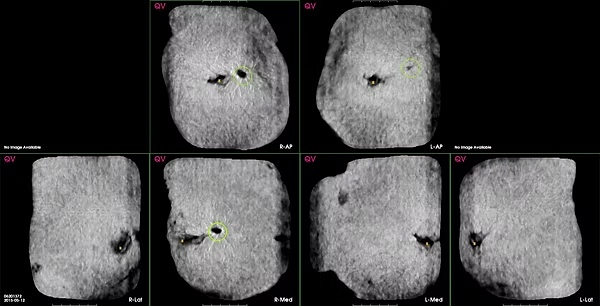
QVCAD identifies lesions through CAD marks (green circles) and dark holes in the navigator image. CAD marks, whether accompanied by dark holes or not, indicate highly suspicious lesions, while dark holes without CAD marks suggest less suspicious or benign lesions.
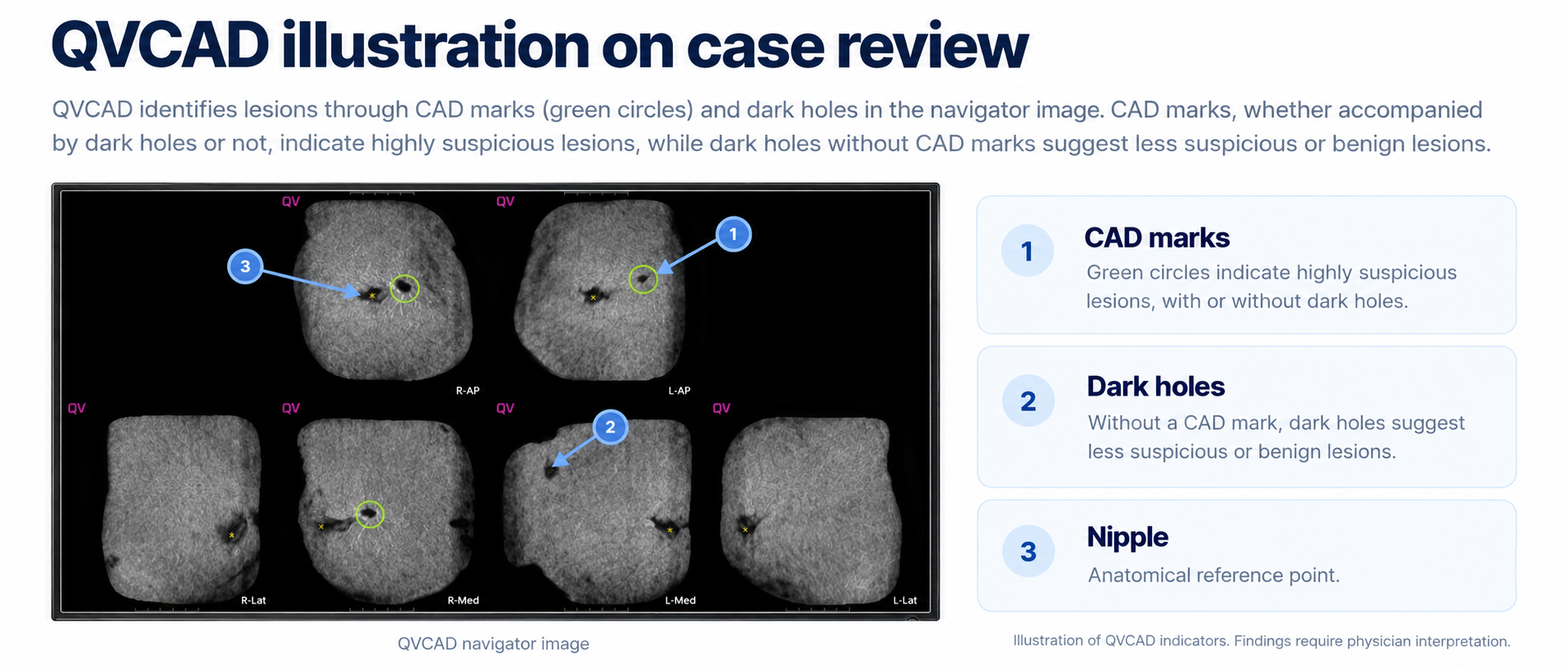
Illustration of QVCAD indicators. Findings require physician interpretation. View full illustration →
Clinical evidence / FROC
How QVCAD balances cancer detection and false-positive marks.
| Sensitivity | Specificity | FP/Volume | |
|---|---|---|---|
| CAD mark | 93% | 66% | 0.07 |
| Dark hole | 99% | 19% | 0.3 |
* Sensitivity and specificity are calculated on a per-patient basis. FP/Volume represents the average number of false-positive marks per ABUS view, measured using normal cases.
How QVCAD works
QVCAD analyzes Automated Breast Ultrasound images and presents marked findings for concurrent radiologist review.
Volumetric breast ultrasound images are acquired.
QVCAD evaluates the image data for suspicious findings.
AI marks are available during interpretation.
The radiologist applies expertise with added decision support.
Why QView
Intelligent detection helps direct attention to findings that may require closer review.
Read ABUS cases at least 3x faster with QVCAD, based on experienced-user feedback.
Developed specifically for Automated Breast Ultrasound—not adapted from another modality.
Clinical evidence
QVCAD is supported by clinical evaluation designed to measure both detection performance and workflow impact.
Explore the EvidenceRead ABUS cases at least 3× faster with QVCAD.*
*Based on feedback from six experienced QVCAD users, who had interpreted an average of more than 20,000 ABUS cases each.
Our story
The team’s work spans the breakthroughs that made screening mammography possible, shaped digital breast imaging, pioneered CAD, advanced Automated Breast Ultrasound, and now power AI for ABUS.
50-100x lower dose - helping make breast cancer screening possible.
Co-invented with Russell Morgan. U.S. Patent 4,598,369.
Pioneering computer-aided detection. Acquired by Hologic in 2006.
U-Systems advanced ABUS and was acquired by GE in 2012.
FDA-approved AI purpose-built for ABUS.
“The future of breast imaging combines experienced radiologists with intelligent AI.”
QView Medical — Built for radiologists. Proven in practice.
Discover how FDA-approved AI can support your ABUS reading workflow.